

Note
Go to the end to download the full example code.
FISTA with a TV proximal step#
FISTA, which reaches a TV-regularised solution faster than gradient methods.
Source: Python/demos/d20_Algorithms05.py · MATLAB/Demos/d20_Algorithms05.m
MATLAB version of this demo
%% DEMO 20:  Algorithms 05. FISTA with TV proximal
%
%
%  This demo presents the FISTA algorithm in TIGRE. using a total variation proximal.
%  Total variation algorithms try to minimize the variation (gradient) of the
%  image, assuming it's piecewise smooth, as most things in nature are (i.e.
%  human body). FISTA attempts to perform this with much faster convergence
%  than standard gradient algorithms such as SIRT.
%
%
%--------------------------------------------------------------------------
%--------------------------------------------------------------------------
% This file is part of the TIGRE Toolbox
%
% Copyright (c) 2015, University of Bath and
%                     CERN-European Organization for Nuclear Research
%                     All rights reserved.
%
% License:            Open Source under BSD.
%                     See the full license at
%                     https://github.com/CERN/TIGRE/blob/master/LICENSE
%
% Contact:            tigre.toolbox@gmail.com
% Codes:              https://github.com/CERN/TIGRE/
% Coded by:           Ander Biguri, Reuben Lindroos
%--------------------------------------------------------------------------
%% Initialize
clear;
close all;

%% Define Geometry
geo=defaultGeometry('nVoxel',[128;128;128]);

%% Load data and generate projections
% see previous demo for explanation
angles=linspace(0,2*pi-2*pi/30,30);
head=headPhantom(geo.nVoxel);
projections=Ax(head,geo,angles,'interpolated');
noise_projections=addCTnoise(projections);

%% FISTA is a quadratically converging algorithm.

% 'hyper': This parameter should approximate the largest
%          eigenvalue in the A matrix in the equation Ax-b and Atb.
%          Empirical tests show that for, the headphantom object:
%
%               geo.nVoxel = [64,64,64]'    ,      hyper (approx=) 2.e6
%               geo.nVoxel = [512,512,512]' ,      hyper (approx=) 2.e4
%          Default: 2.e8
% 'tviter':  Number of iterations of Im3ddenoise to use. Default: 20
% 'lambda':  Multiplier for the tvlambda used, which is proportional to
%            L (hyper). Default: 0.1
% 'verbose': get feedback or not. Default: 1
%--------------------------------------------------------------------------
imgFISTA_default = FISTA(noise_projections,geo,angles,100);

%% Adding a different hyper parameter
imgFISTA_hyper = FISTA(noise_projections,geo,angles,100,'hyper' ,2.e6);

%% Recon more significant tv parameters
imgFISTA_hightv = FISTA(noise_projections,geo,angles,100,'hyper',2.e6,'tviter',100,'lambda',20);

%% Faster converging FISTA
imgFISTA_mod = FISTA(noise_projections,geo,angles,100,'hyper',1.e5,'tviter',100,'lambda',20,'fista_q',1/50,'fista_p',1/20);

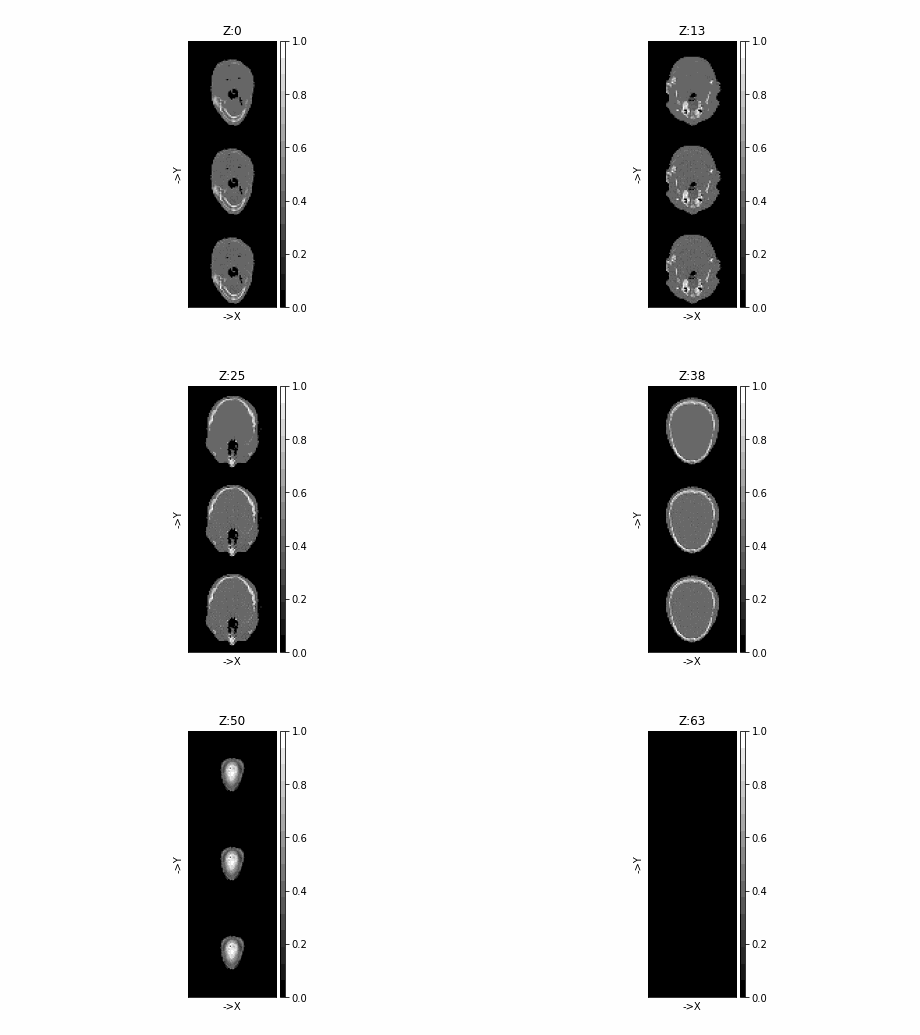
%% Plot results
plotImg([imgFISTA_default,imgFISTA_hyper,imgFISTA_hightv,imgFISTA_mod])
Initialize#
import tigre
import numpy as np
from tigre.utilities import sample_loader
from tigre.utilities import CTnoise
import tigre.algorithms as algs
from matplotlib import pyplot as plt
Geometry#
geo = tigre.geometry_default(high_resolution=False)
Load data and generate projections#
# define angles
angles = np.linspace(0, 2 * np.pi, 100, endpoint=False)
# Load thorax phantom data
head = sample_loader.load_head_phantom(geo.nVoxel)
# generate projections
projections = tigre.Ax(head, geo, angles)
# add noise
noise_projections = CTnoise.add(projections, Poisson=1e5, Gaussian=np.array([0, 10]))

## FISTA is a quadratically converging algorithm.

# 'hyper': This parameter should approximate the largest
#          eigenvalue in the A matrix in the equation Ax-b and Atb.
#          Empirical tests show that for, the headphantom object:
#
#               geo.nVoxel = [64,64,64]'    ,      hyper (approx=) 2.e8
#               geo.nVoxel = [512,512,512]' ,      hyper (approx=) 2.e4
#          Default: 2.e8
# 'tviter':  Number of iterations of Im3ddenoise to use. Default: 20
# 'lambda':  Multiplier for the tvlambda used, which is proportional to
#            L (hyper). Default: 0.1
# 'verbose': get feedback or not. Default: 1
# --------------------------------------------------------------------------
imgFISTA_default = algs.fista(noise_projections, geo, angles, 100)

## Adding a different hyper parameter
imgFISTA_hyper = algs.fista(noise_projections, geo, angles, 100, hyper=2.0e6)

## Recon more significant tv parameters
imgFISTA_hightv = algs.fista(
    noise_projections, geo, angles, 100, hyper=2.0e6, tviter=100, tvlambda=20
)

## Plot results
tigre.plotimg(
    np.concatenate([imgFISTA_default, imgFISTA_hyper, imgFISTA_hightv], axis=1),
    dim="z",
    clims=[0, 1],
)
using SVD power method to calculate Lipschitz const
error for val is:inf
error for val is:20.288054
error for val is:14.836177
error for val is:14.145595
error for val is:14.238516
error for val is:14.48735
error for val is:14.75272
error for val is:15.006372
error for val is:15.24479
error for val is:15.469367
FISTA: estimated hyper (Lipschitz constant) = 7.511e+05 (2 x sigma_max(A)^2 via svd_power_method)
FISTA algorithm in progress.
Estimated time until completion : 00:00:03
Algorithm will finish at        : 16:51:07
FISTA algorithm in progress.
Estimated time until completion : 00:00:02
Algorithm will finish at        : 16:51:08
FISTA algorithm in progress.
Estimated time until completion : 00:00:02
Algorithm will finish at        : 16:51:11
Total running time of the script: (0 minutes 15.916 seconds)